Nine schools of thought
Explore nine traditions, from Classical and Keynesian economics to Austrian and Institutional approaches. Bring competing explanations into the same discussion.
Explore the nine schools Noscere
 is macroeconomics simulation software for teaching. Use the interactive textbook and Swedish economy powered by the Hermetic Engine, or compare monetary policy rules in the separate US laboratory.
Households spend and save. Firms hire and invest. Banks assess credit. Hermetic brings their decisions together with output, inflation, interest rates and the public finances in one economic simulation.
In Noscere, let students follow a policy through those relationships. See how a change reaches borrowing, demand, production and trade, and why its consequences can keep unfolding long after the decision.
Hermetic EngineOutput, inflation, interest rates and expectations.
Spending, saving, hiring, investment and credit decisions.
Debts, deposits, assets, liabilities and cross-border accounts.
Four learning paths offer 25 activities at beginner and advanced levels. Ask students to predict, change a setting, inspect the result and explain what they learned. Teacher guides and assignments help you build the session around that sequence.
Explore nine traditions, from Classical and Keynesian economics to Austrian and Institutional approaches. Bring competing explanations into the same discussion.
Explore the nine schoolsChange an interest rate, spending decision or supply condition. Start from the same opening and seed, then compare the scenario with its baseline.
See the teaching workflowGive the discussion 120 reviewed indicators from Noscere to work with. Inspect the charts, check the definitions and take full-precision CSV results into assignments and further analysis.
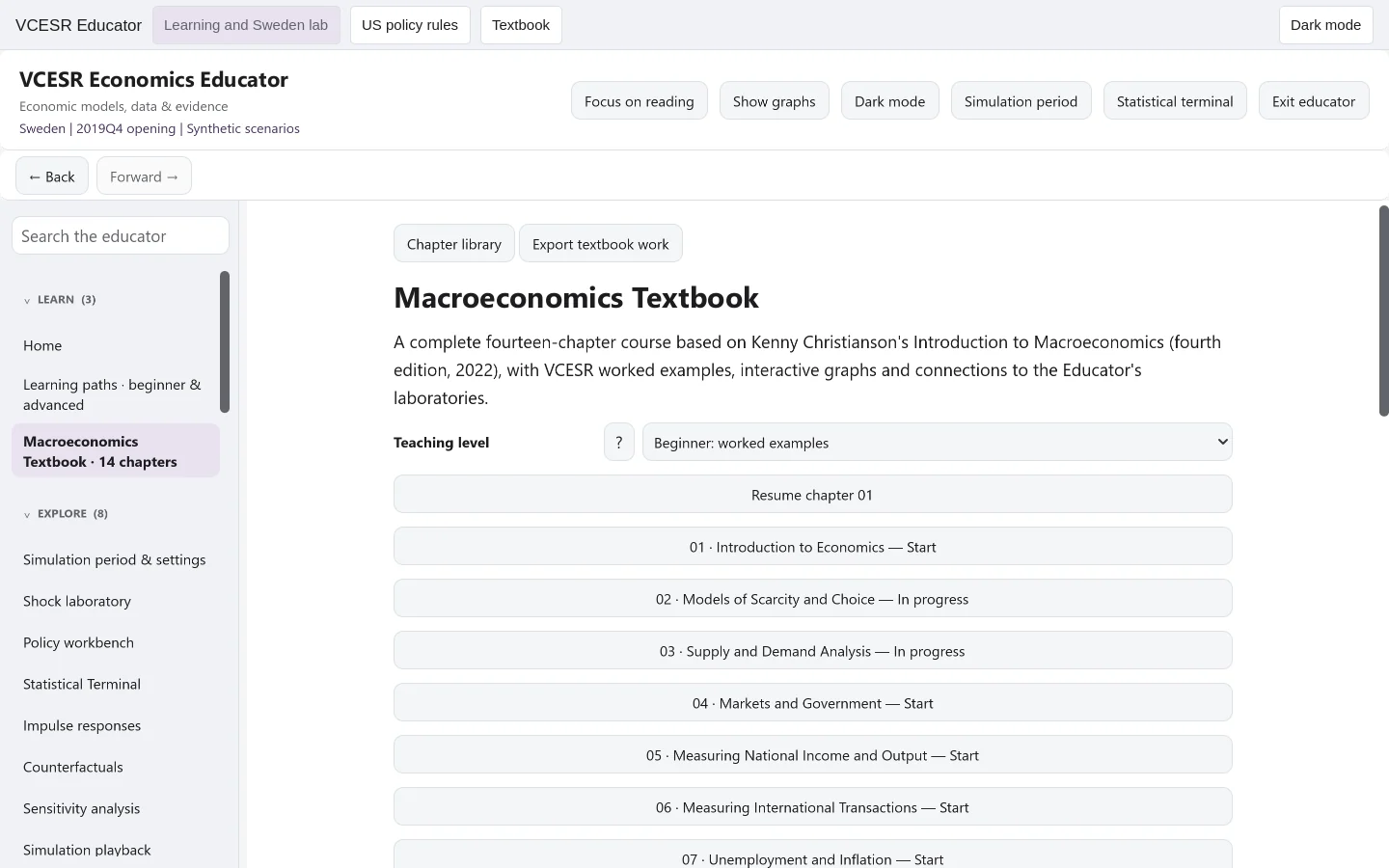
Understand the modelTake students from scarcity and national accounts to banking, fiscal policy and expectations in a 14-chapter course. Worked examples, interactive graphs and exact result tables turn each topic into something they can investigate.
Choose a beginner or advanced path. Students record a prediction, change the controls, check their reasoning and reflect on the result. Chapter links carry the discussion into the Sweden and US laboratories, then bring them back to their reading.
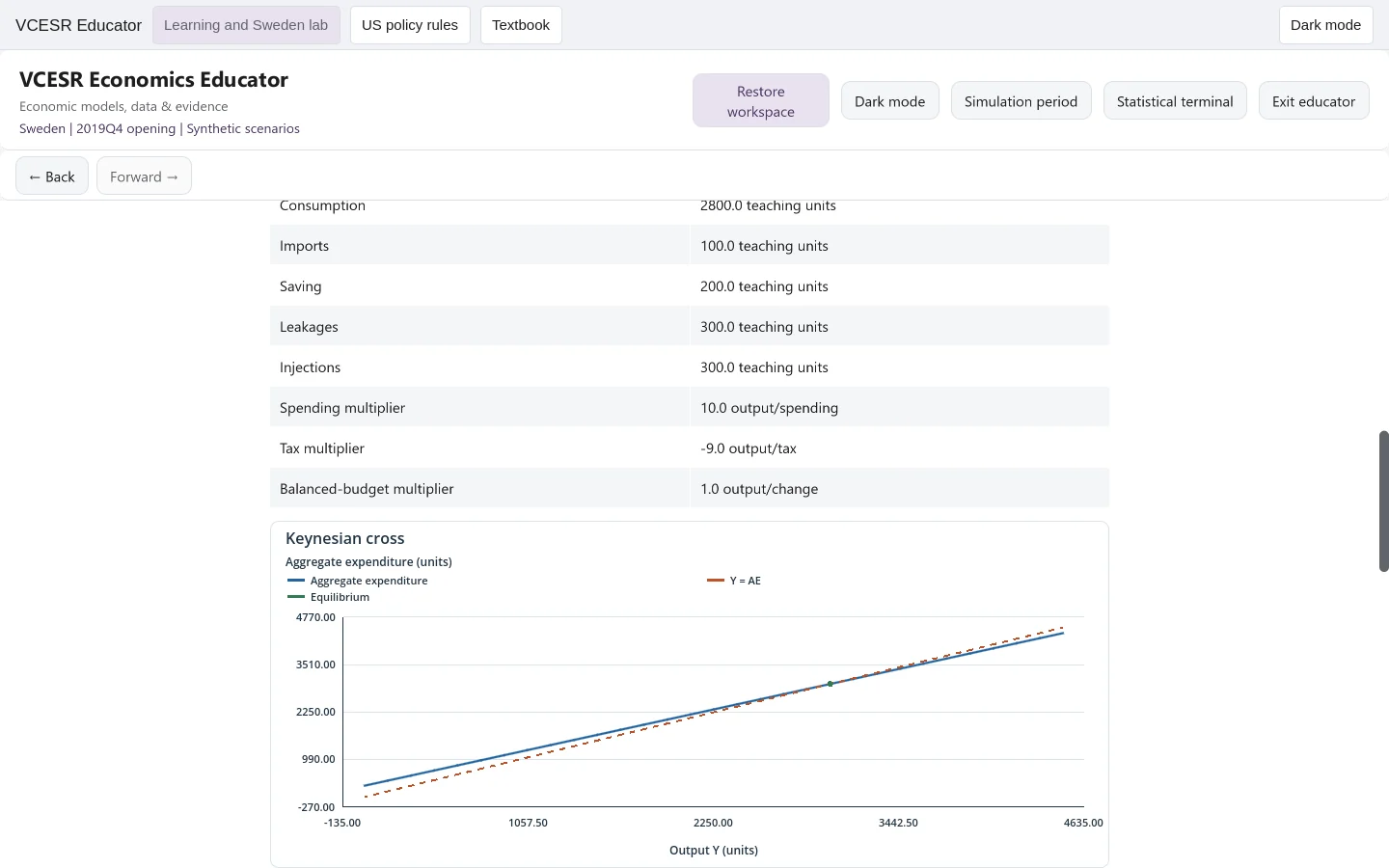
A tax change is a starting point. Build a public-investment programme, combine reforms, or test an oil shock. Choose the available levers and find out how they interact.
Change the policy rate, explore tax settings, and adjust infrastructure, welfare, education or healthcare spending. Follow the trade-offs across growth, prices, credit and the public accounts.
Explore a 67-entry policy catalogue spanning labour, housing, business, banking, trade and more. Combine available instruments and give each its own start and end quarter.
Try a change in confidence, productivity, oil prices or foreign interest rates. Set the size and timing, with duration controls where the experiment supports them.
Hold selected assumptions at your own values, including expected inflation, the natural real interest rate or potential growth. Use sensitivity experiments to see which results depend on those choices.
Choose a seed and a horizon of 4–80 quarters. Return to a recorded quarter, branch an alternative policy, or compare a joint package with its individual interventions.
Compare baselines and scenarios in the statistics workspace. Examine the growth response and the accumulated difference in real output, then export the data behind the charts.
The selected institutional framework determines which policies are available. The interface explains restrictions and identifies institutional counterfactuals, so students can distinguish a policy experiment from the rules Sweden currently uses. These controls belong to Noscere; the US workspace has its own monetary-policy experiments.
Give the experiment a real economic context. Noscere calibrates its starting conditions to dated Swedish observations and estimates, bringing GDP, inflation, public finances, trade and policy settings into the same classroom economy.
Choose an opening from 2013 to 2025. Explore how the same decision plays out from different initial conditions, with historical Riksbank rates, oil prices and US monetary conditions as part of the external backdrop.
License optionsSource series include IMF, Sveriges Riksbank, Statistics Sweden and Eurostat.
Swedish calibration anchors the starting conditions. Behavioural responses remain model assumptions, and subsequent domestic paths are simulated. Noscere supports teaching and exploration; it is not a validated policy forecast.
Compare two monetary-policy rules under the same shock. Adjust their responses to inflation and the output gap.
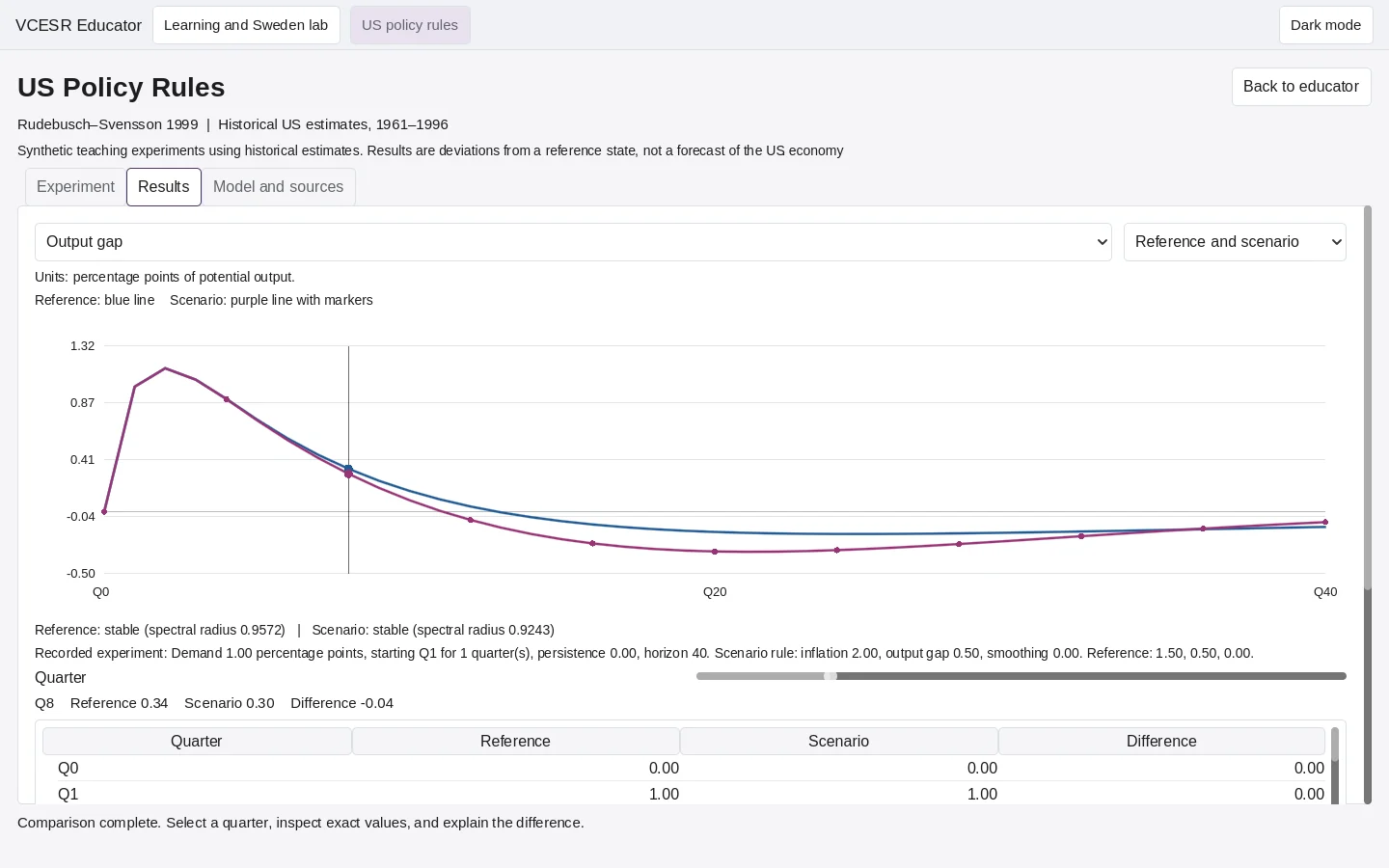
Choose a demand, cost-push or monetary shock. Set its timing and persistence over 8–80 quarters, then adjust the inflation response, output-gap response and rate smoothing.
Inspect the output gap, GDP-deflator inflation and federal funds rate. Match each chart to its exact table, compare rules and see the model’s stability assessment.
Save a comparison with its recorded settings and results. Export full-precision CSV data and supporting metadata for assignments, discussion or further analysis.
A separate model within the same application: US Policy Rules uses Rudebusch–Svensson’s published 1999 relationships, estimated on 1961–1996 US data. These are synthetic teaching experiments using a historical specification. They do not describe today’s US economy or produce current forecasts. The classroom exercise and worksheet compare two rules under the same shock.
Why do economists expect different outcomes from the same policy? Explore the mechanisms each school emphasises, and use the model to frame a more precise discussion.
Choose a single license for individual use, or speak with our sales team about a model and teaching support for your organisation.
€241.94 including Dutch VAT (21%)
€199.95 excluding VAT. Your final tax and total depend on your billing location and are confirmed at checkout.
Available releases and supported payment methods are shown in our shop. Checkout is hosted securely by Stripe.
After a confirmed purchase, we email your offline licence file and a private installer download link. Review the supported Windows version and licence terms before purchasing.
Custom economic models and educational support for schools, institutions and companies.
Teachers, students and independent learners who want to connect economic ideas with experiments. Beginner activities build intuition; advanced activities add equations, assumptions and reflections. Guided lessons and free exploration are both available in the same standalone desktop application.
A 14-chapter macroeconomics course with worked examples, interactive graphs, exact tables, answer explanations and beginner and advanced study. It includes 22 teaching activities, six companion lessons and three capstones, with chapter links to relevant Sweden and US experiments. Students can save their progress and export their work.
Noscere uses the Hermetic Engine to explore fiscal, monetary and structural policies from six dated Swedish openings: 2013 Q4, 2015 Q4, 2019 Q4, 2023 Q4, 2024 Q4 and 2025 Q4. US Policy Rules uses a separate model to compare monetary-policy responses to shared shocks. Its published US relationships were estimated on 1961–1996 data; it is not a model of today’s US economy.
Start with a question and ask students for a prediction. Read a chapter or choose a guided activity, change a setting, inspect the result and ask them to explain it. Four learning paths contain 25 activities with teacher guides and assignments. You can use selected activities in a class session or leave space for independent exploration.
In Noscere, choose a dated opening, a seed and a 4–80-quarter horizon. Schedule available policies, combine interventions, introduce shocks and compare alternative paths. In US Policy Rules, choose an 8–80-quarter horizon, set a demand, cost-push or monetary shock and adjust the scenario’s policy responses. Each workspace explains its controls and assumptions.
Yes. Textbook reading, chapter source text and teaching activities work offline. Progress is stored locally, and teacher material and learner work can be exported. The textbook and the two laboratories keep their own progress or experiment records.
Yes. The textbook exports learner work, teaching text, graph images and calculated values. The Sweden Statistical Terminal offers 120 reviewed indicators, chart comparisons and full-precision CSV data. US comparisons export their recorded results as CSV with metadata describing units, settings and provenance.
No. They are teaching experiments. Swedish observations and estimates anchor selected starting conditions, while the model determines the subsequent simulated path. The US laboratory uses a historical estimated specification. Use results to discuss mechanisms, assumptions and trade-offs; they are not validated forecasts.
A single licence is €199.95 excluding VAT (€241.94 including Dutch VAT at 21%). Check available releases in our shop. After Stripe confirms payment, we email your .noscere-license file and a private installer download link. Install Noscere, then import the licence file for offline use. Keep the file for reinstallations. Recover purchase access using the email address used at checkout. Noscere runs independently of Boom and Bust and does not require Steam.
Yes. Our expert modellers build custom economic models in house for schools, institutions and companies. We also provide educational support to connect a model with your lessons or workshops. Contact our sales team to discuss your teaching goals, scope and licensing.